
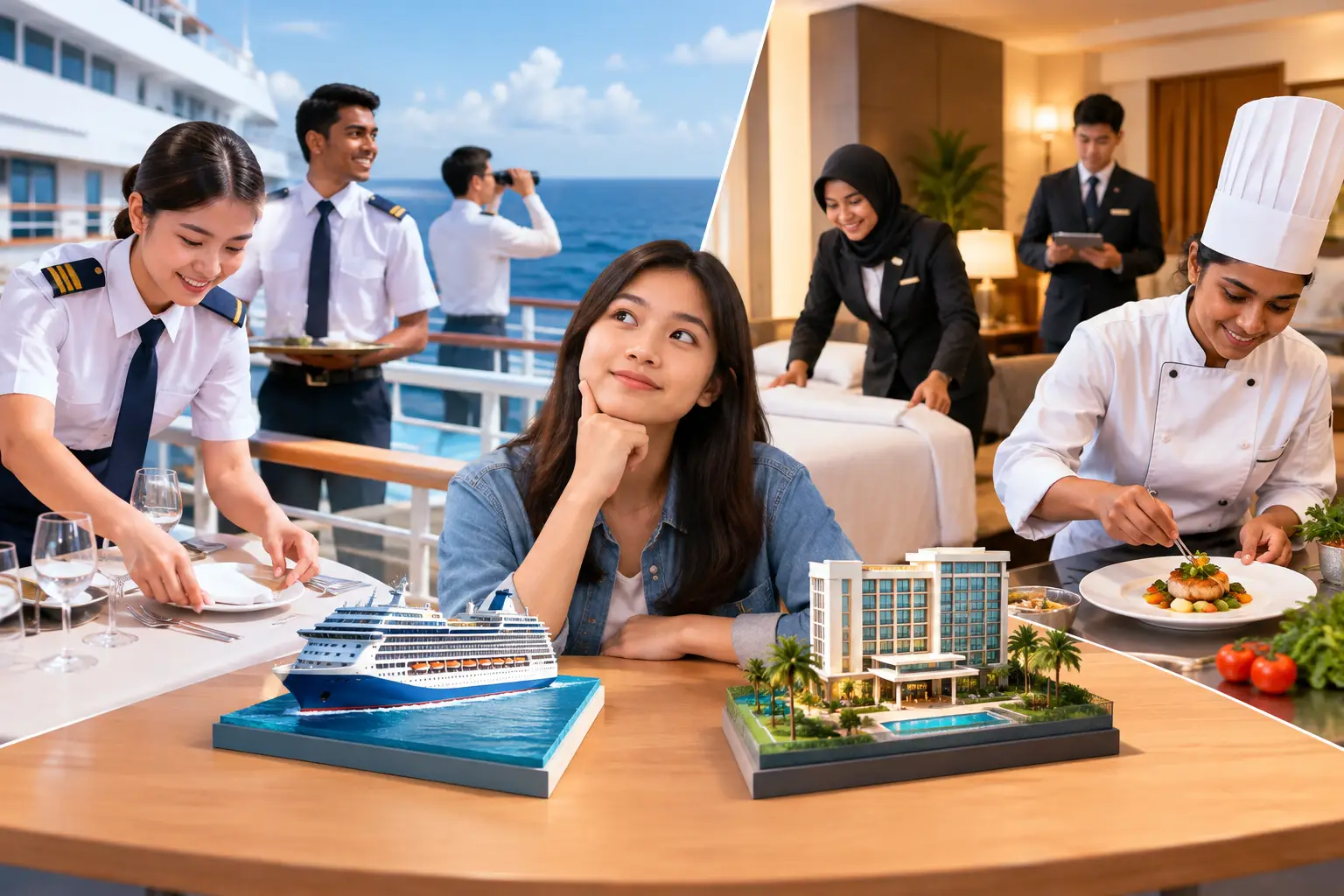
A busy breakfast service can reveal what classroom brochures cannot. One learner may enjoy arranging a buffet, speaking with guests, and keeping service moving. Another may be drawn to the fast pace of ship life, where teamwork, safety procedures, and guest care happen far from home. When comparing cruise academy versus hotel school, the right choice comes down to the work environment you want to build skills for – not which path sounds more impressive.
Both options can lead to meaningful hospitality careers. Both require discipline, a service mindset, and the ability to work well with people. The difference is in the daily realities they prepare you for. Before you enroll, picture the shifts you want, the teams you want to join, and the kind of challenge that energizes you.
Cruise Academy Versus Hotel School: The Main Difference
A cruise-focused program prepares students for hospitality work in the cruise industry and related guest-service environments. Training commonly centers on onboard operations, passenger expectations, safety awareness, multicultural teamwork, service standards, and the flexibility needed for life at sea. You are learning how to serve guests in a contained, highly organized environment that operates around the clock.
A hotel school usually prepares students for land-based hospitality. Depending on the program, this can include front office operations, housekeeping, food and beverage service, event support, guest relations, and hotel administration. The work is still people-focused, but the routines are shaped by a property, its local guests, its facilities, and its operating departments.
Neither path is automatically broader or better. A hotel route may suit someone who wants to develop within resorts, city hotels, restaurants, or events. A cruise route may suit someone excited by international guests, structured onboard teams, and an experience that combines hospitality with travel. Your career direction should lead the decision.
What You Learn in Each Setting
Cruise training builds readiness for a unique workplace
Cruise hospitality is not simply hotel service on water. Ships have distinct safety cultures, schedules, guest activities, crew areas, and reporting structures. Students need to become comfortable following procedures precisely while staying warm, attentive, and calm with guests.
Practical cruise and hospitality training can develop skills such as professional communication, table service, guest handling, grooming standards, teamwork across cultures, and problem-solving under pressure. You may practice responding to a guest request during a packed service period, preparing a dining area to standard, or coordinating with colleagues when plans change quickly.
The strongest training does not stop at theory. It gives you repetitions. Our mentors believe confidence grows when you have practiced the same professional standard until it becomes natural: greeting a guest, carrying a tray safely, explaining a menu item, checking a room detail, or handling feedback with composure.
Hotel school training can offer wider department exposure
Hotel programs often introduce the full guest journey, from reservation and arrival to dining, events, housekeeping, and departure. This can be valuable if you are still deciding which department fits you. You might discover that you enjoy front desk communication more than back-of-house operations, or that banquets and events bring out your organizational strengths.
Because hotels come in many formats, hotel training can also be flexible. A boutique property, business hotel, resort, convention venue, and restaurant all need hospitality professionals, but their service rhythms differ. A broad hotel foundation may help you move between departments or pursue roles closer to home.
That said, breadth only helps if it comes with real practice. Look for training that lets you work with service equipment, complete realistic guest scenarios, follow workplace procedures, and receive direct feedback. Watching someone fold a napkin is different from doing it well during a timed table setup.
Consider the Lifestyle, Not Just the Job Title
This is where a cruise academy versus hotel school decision becomes personal. Cruise work can offer exposure to people from many countries and an environment where your work and living routines are closely connected. It also asks for adaptability. Time away from home, shared crew spaces, and demanding schedules can be part of the experience.
For some students, that is exactly the appeal. They want a workplace that feels international, active, and different from a standard nine-to-five routine. For others, a hotel career may be a better match because it can provide more local stability, easier access to family life, or a clearer path in a preferred city or region.
Be honest with yourself about your energy. Do you enjoy meeting new people every day? Can you stay professional when the shift is busy? Are you comfortable with structured rules and working as part of a large team? These questions matter more than choosing a course based on a trend or a friend’s opinion.
Qualifications and Hands-On Experience Matter
Hospitality employers want people who can contribute from day one, but that does not mean they expect you to know everything. They look for service habits, a willingness to learn, reliable communication, and an understanding of professional standards. A recognized qualification helps show that you have trained with purpose. Hands-on experience shows that you can apply what you learned.
When reviewing a program, ask how often students practice in realistic settings. Find out whether the curriculum includes food and beverage service, guest interaction, workplace communication, hygiene, safety awareness, and teamwork. Ask how instructors assess practical performance, not only written work.
At Ambitious Academy, we focus on industry-relevant learning because hospitality is a craft you build through action. A student may begin by learning the steps of formal service, then progress to handling a guest scenario with confidence and supporting a team during a simulated operation. Those small improvements are the foundation of professional readiness.
Digital tools also have a place in modern hospitality training. Learners can use digital scheduling, presentation tools, customer feedback data, and AI-assisted practice prompts to strengthen communication and preparation. These tools can help you organize ideas or rehearse scenarios, but they cannot replace your eye contact, judgment, timing, and genuine care for a guest.
Questions to Ask Before You Enroll
The right academy or school should give clear answers, not vague promises. Ask what qualification you will receive and whether it is recognized for the career path you want. Ask who teaches the practical sessions, how much time is spent learning by doing, and what facilities you will use.
You should also ask what entry roles graduates commonly prepare for. Cruise-focused training may point toward onboard dining, guest service, housekeeping, or hospitality support roles. Hotel training may prepare you for front office, restaurant service, events, reservations, or room operations. Job titles vary by employer, so focus on transferable skills rather than one specific label.
Finally, visit if you can. Notice whether the learning space feels active and purposeful. Speak with a mentor. Ask to see what a practical lesson looks like. The right environment should make you feel challenged, supported, and ready to take your next step.
Choose the Path That Matches Your Direction
Choose cruise training if you are excited by a structured international environment and want to prepare for the particular expectations of onboard hospitality. Choose hotel school if you want broad exposure to land-based operations or see yourself growing through local hotels, resorts, restaurants, and events. If you are unsure, a hospitality program with strong practical foundations can give you room to clarify your direction while building useful skills.
Your grades do not define whether you can succeed in this field. Determination, practice, and professional habits do. Start by writing down the kind of guest experience you would be proud to deliver, then choose the training that gives you the most real opportunities to practice it.