
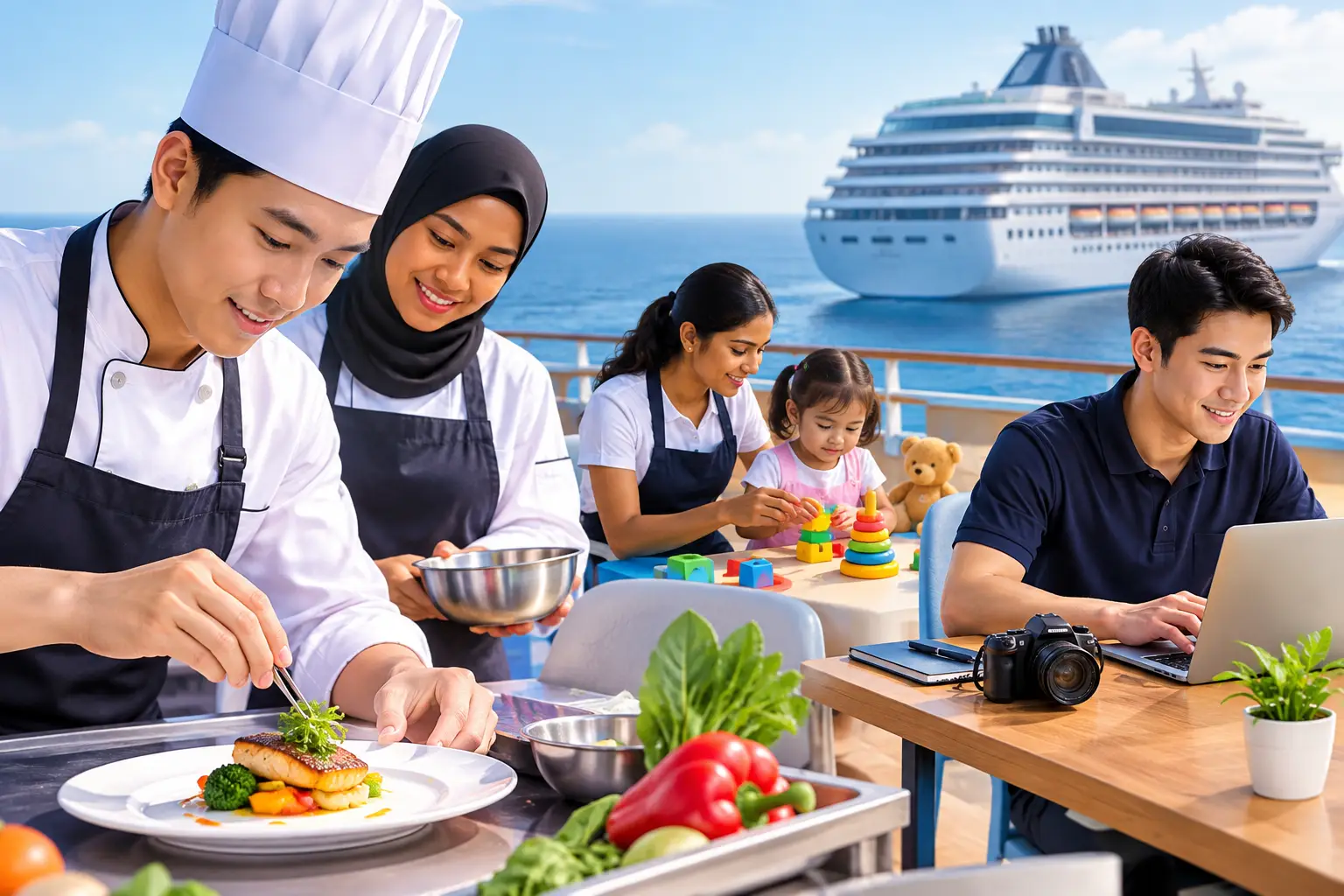
A cruise ship breakfast service can involve hundreds of guests, multiple dietary requests, tight timing, and a team working across several nationalities. It is not a job for someone who only enjoys the idea of travel. It is a career for someone who can stay calm, work with care, communicate clearly, and take pride in service.
For students considering future cruise careers in Malaysia, that is the real starting point. A role at sea can take you far beyond your hometown, but the habits that make you employable are built on the ground: professional standards, practical skill, teamwork, and the confidence to keep learning.
What Future Cruise Careers in Malaysia Can Look Like
Cruise and hospitality careers are broader than many people expect. Guests see the polished result: a welcoming dining room, a spotless cabin, a beautifully presented dessert, or a helpful crew member who remembers their preference. Behind that experience is a large, highly organized operation with people in food service, housekeeping, front office support, galley kitchens, guest activities, retail, wellness, and technical departments.
For young adults with an interest in food and hospitality, entry pathways often connect to restaurant service, bar operations, kitchen production, pastry, and guest relations. The exact role depends on your training, communication skills, health requirements, and the needs of the employer. Some people begin in hotel or restaurant settings before applying for cruise opportunities. Others build a focused hospitality foundation and prepare specifically for the pace of life at sea.
A cruise career is not simply a long holiday with a uniform. Contracts may require extended periods away from home, shared crew accommodation, rotating shifts, and consistent performance even on busy days. For the right person, those realities are part of the attraction: international exposure, disciplined work experience, and the chance to become more capable in a fast-moving environment.
The Skills Cruise Employers Notice First
A recognized qualification matters, but employers also look for proof that you can use what you have learned. That is why hands-on training should sit at the center of your preparation.
In food and beverage service, you need more than knowledge of table settings. You need to carry yourself professionally, understand service sequences, handle guest requests respectfully, and work efficiently with the kitchen and service team. A small detail, such as checking an allergy note or clearing a table at the right moment, can shape a guest’s experience.
In culinary and patisserie roles, consistency matters just as much as creativity. A dish must meet the standard every time, often at volume and under time pressure. You also need strong habits in food safety, mise en place, portion control, cleaning, and communication. These are not glamorous skills, but they are the skills that keep a kitchen dependable.
For guest-facing roles, spoken English is particularly useful because cruise teams and passengers come from many countries. You do not need to sound perfect. You do need to listen carefully, speak with respect, and know how to ask for clarification when you are unsure. Clear communication prevents small problems from becoming stressful ones.
The strongest candidates also understand teamwork. On a ship, no department works entirely alone. A delayed meal, a missing room item, or a special celebration may involve several teams. Being reliable, responsive, and easy to work with builds the kind of reputation that can support long-term growth.
Training for the Reality, Not Just the Interview
A polished resume can help you get noticed. Practical ability helps you stay ready once the work begins.
At Ambitious Academy, we believe vocational training should feel close to the workplace. That means practicing real service routines, learning in kitchen and hospitality environments, receiving feedback from mentors, and repeating key techniques until they become natural. A student preparing a buffet setup, managing a simulated guest request, or coordinating with classmates during service is developing more than a checklist of tasks. They are learning how to think while working.
This is valuable because cruise work can be demanding in ways that are hard to learn from videos alone. You may need to reset a dining area quickly, respond politely to a frustrated guest, or adapt when a supervisor changes the plan. Classroom theory gives you context. Repeated practice builds your response.
Recognized qualifications can also show employers that your training follows a structured standard. When comparing programs, ask what practical modules are included, how assessment works, whether trainers have relevant industry experience, and how often students practice in realistic settings. A certificate should represent capability, not just attendance.
Digital Tools Are Part of Modern Hospitality
Cruise and hospitality work remains deeply human. Guests remember warmth, attentiveness, and a service moment that feels personal. Technology does not replace that human touch, but it can help you work more accurately and efficiently.
Digital ordering systems, booking platforms, inventory tools, guest feedback dashboards, and scheduling software are already common across hospitality. AI tools can help teams organize information, draft basic guest communication, translate simple phrases for learning, or identify patterns in feedback. The professional skill is knowing when to use a tool and when to rely on your own judgment.
For example, a service team may use digital records to understand a guest’s dietary needs, but a thoughtful crew member still confirms the details respectfully. A kitchen may use forecasting data to reduce waste, but a chef still checks quality, taste, and presentation. Your craft remains the center. Digital confidence simply gives you another useful advantage.
Is Life at Sea the Right Fit for You?
Before making a plan, be honest about what you want from your work. Future cruise careers can suit people who enjoy meeting new people, adapting to routines, working as part of a diverse team, and being accountable for high service standards. They may be less suitable if being away from family for long stretches would create difficulties you are not ready to manage.
It also depends on your preferred career direction. If your goal is to become a chef, pastry professional, bartender, or restaurant supervisor, cruise experience can sharpen your discipline and expose you to large-scale operations. If you are most interested in marketing, creative media, or business, hospitality skills may still be useful, but a shipboard role may not be your most direct route.
There is no need to rush into a decision because a career sounds exciting. Visit a campus, speak with a mentor, and ask practical questions. What does a typical shift involve? Which skills do I need to improve first? What qualifications fit my chosen role? What personal commitments should I consider before working away from home?
Build a Career Plan You Can Act On
Start by choosing the department that genuinely interests you. If you enjoy creating food, look closely at culinary, pastry, or Chinese cuisine training. If you enjoy interacting with people and creating memorable moments, cruise and hospitality or food and beverage training may be a better match.
Then focus on building evidence of your ability. Take practical sessions seriously. Learn the correct terminology. Practice your English communication. Show up on time, keep your work area organized, and accept feedback without taking it personally. These habits are often what turn potential into professional readiness.
You can also prepare for interviews by learning how to describe your skills with specific examples. Instead of saying, “I am hardworking,” explain how you handled a busy service task, followed food safety procedures, or supported a teammate when plans changed. Employers remember clear examples because they show how you work.
A career at sea begins long before you step onto a ship. It begins the day you decide that your passion deserves practical training, honest feedback, and the discipline to improve. If that feels like your direction, take the next step with purpose: talk to a mentor, explore the right program, and start building skills that can travel with you.