
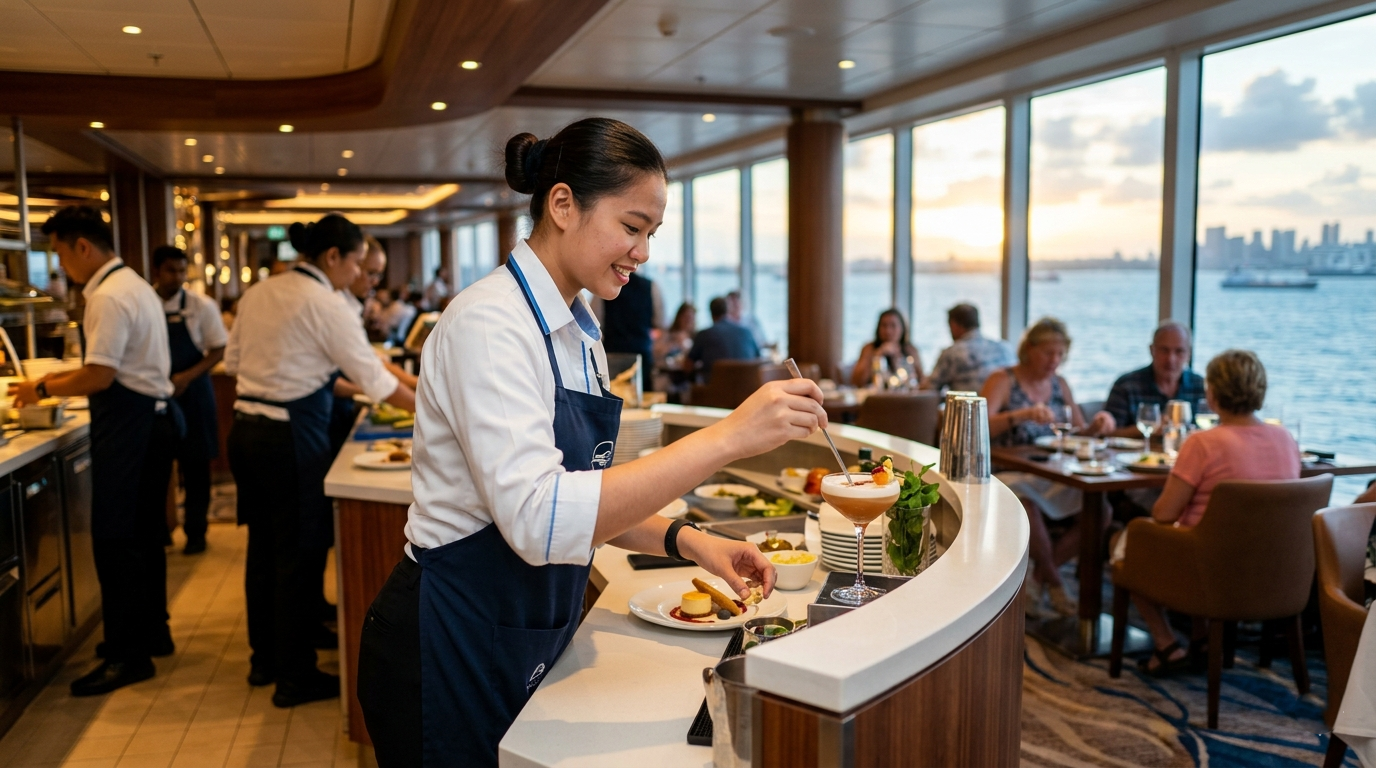
When people think about working on a cruise ship, the first things that come to mind are usually attractive salaries, international travel, and accommodation provided by the company. The next question is often: what should I learn before working on a cruise ship?
The reality is that getting hired is not determined by how badly you want the job. It depends on whether you have developed the essential skills that employers are looking for. A cruise ship is not a holiday destination; it is more like a floating hotel operating 24 hours a day. Cruise companies are not looking for dreamers—they are looking for people who can contribute from day one.
Don’t Focus Only on Job Titles
Many students start by asking whether they should become a chef, pastry cook, restaurant crew member, housekeeping staff, or front office personnel. While choosing a career path is important, it is even more important to understand that cruise companies hire based on transferable skills.
Employers want to know whether you can perform consistently in a high-pressure environment, work with colleagues from different countries, and follow strict service standards.
If you are just starting your journey, focus on developing three core competencies:
- English communication
- Service mindset
- Professional skills
Specific job roles can come later, but without these foundations, even the best-looking resume may not get you very far.
Priority #1: Functional English, Not Exam English
Many students feel intimidated by English, especially if they struggled with it in school. However, cruise companies are not looking for perfect essays or flawless grammar. They want employees who can understand instructions, communicate with guests, and work effectively with colleagues.
Restaurant staff need to explain menu items, handle guest requests, and respond to complaints. Housekeeping staff must communicate room-related information and explain service procedures. Kitchen crew may require less speaking, but they still need to understand food safety instructions, production standards, and team communication.
In the cruise industry, practical communication matters far more than academic English. Instead of memorising vocabulary lists, focus on learning workplace conversations, hospitality terminology, and real-life service scenarios.
Priority #2: Service Mindset and Professional Image
At its core, the cruise industry is a service industry—and one with very high expectations. Guests pay a premium for their experience and expect professional service throughout their journey.
Success is not only about completing tasks. It is about making guests feel welcomed, comfortable, and valued.
Many young people are technically skilled but overlook soft skills such as:
- Professional appearance
- Positive body language
- Polite communication
- Fast response time
- Emotional control under pressure
These qualities may not seem like technical skills, but they often determine long-term success in hospitality careers.
Service excellence is not something people are born with. It is developed through training, practice, and real-world experience.
Priority #3: A Practical Skill You Can Use Immediately
Cruise companies are unlikely to hire someone simply because they are willing to do anything. Candidates with clear and practical skills usually stand out more.
Common cruise ship career pathways include:
- Food and Beverage Service
- Culinary Arts
- Pastry and Bakery
- Housekeeping Operations
- Hotel and Hospitality Services
If you are interested in culinary careers, focus on knife skills, food safety standards, mise en place preparation, and kitchen workflow management. Cruise kitchens prioritise consistency, efficiency, and standardisation.
If pastry and bakery is your preferred path, develop strong foundations in recipes, dough preparation, baking techniques, and production efficiency. Cruise ship pastry departments require consistent quality at scale.
If you prefer restaurant service, learn tray handling, table setting, order taking, beverage knowledge, complaint handling, and teamwork. Professional service is much more than simply serving food.
A useful question to ask yourself is: can you perform these tasks repeatedly in a realistic work environment? Being able to do something once in class is very different from doing it consistently during a busy shift.
Why Are Cruise Hospitality Programmes Becoming More Popular in Malaysia?
More Malaysian students are choosing vocational education as a pathway into the international hospitality and cruise industry.
The reason is simple. Employers often value practical skills, workplace communication, and industry experience more than academic qualifications alone.
For example, Ambitious Academy’s Cruise Hospitality Diploma Programme covers areas such as:
- Food & Beverage Service
- Housekeeping Operations
- Cruise Industry Knowledge
- Super Yacht Service Fundamentals
- Workplace English Communication
The goal is not simply to study more subjects, but to expose students to industry standards, workplace expectations, teamwork, and real-world operational practices.
For students planning to enter the hospitality, cruise, or luxury tourism sectors, practical training often provides a stronger foundation than theory alone.
Certificates Matter, But They Should Not Come First
Many students ask whether they should start by collecting certificates.
The answer is yes—but certificates should not be your primary focus.
The cruise industry may require certifications related to safety, food hygiene, or job-specific skills. These qualifications can strengthen your application and, in some cases, are mandatory.
However, certificates alone do not guarantee success. Employers also want to know whether you can handle pressure, adapt to workplace demands, and perform consistently.
The best approach is to build practical skills first and use certifications to support those skills.
Understanding the Reality of Cruise Ship Work
Many people struggle in the cruise industry not because of a lack of technical ability, but because their expectations do not match reality.
Cruise ship jobs often involve:
- Long working hours
- High service standards
- Shared living spaces
- Multicultural teams
- Extended periods away from home
Success requires adaptability, discipline, time management, and resilience.
The good news is that the industry often values attitude and performance more than academic grades. For students who prefer hands-on learning over traditional classroom education, this can be a rewarding career pathway.
AI Can Help You Learn Faster
Preparing for a hospitality career today is different from ten years ago.
AI tools can help students practise English interviews, role-play customer service scenarios, learn hospitality terminology, and improve workplace communication skills.
Culinary students can use AI to create ingredient study guides, understand food costing concepts, and memorise menu terminology. Hospitality students can use AI to practise guest interactions and service procedures.
Practical skills remain essential, but students who know how to use modern learning tools often develop confidence and workplace readiness more quickly.
Where Should You Start?
If you are starting from zero, avoid applying for jobs blindly.
Choose one primary career direction and strengthen two supporting skills.
For example:
- Culinary Arts + English Communication + Professional Etiquette
- Food & Beverage Service + Spoken English + Service Procedures
- Pastry & Bakery + Production Efficiency + Industry Terminology
The cruise industry values people who have a strong core skill and can communicate, collaborate, and adapt effectively.
Most importantly, choose a training environment that provides real equipment, realistic assessments, practical learning, and industry exposure.
Many successful cruise industry professionals were not top academic students. Some simply discovered that they learned better through practical experience than through examinations.
If working on a cruise ship is your goal, stop wondering whether you are suitable and start building the skills that employers need. Learn a practical skill, improve your English communication, develop a service mindset, and take the first step towards your future career.
Interested in a Career in Cruise Hospitality?
Not sure whether Culinary Arts, Pastry & Bakery, Food & Beverage Service, or Cruise Hospitality is the right path for you?
Contact Ambitious Academy to explore your study options and career pathways before making a decision. Understanding your direction first is often more effective than applying for jobs without a clear plan.