
Last Updated: 2 November 2026
Artificial Intelligence (AI) is transforming how businesses promote their products and services. From ChatGPT generating marketing content and AI-powered image and video creation to Google’s AI-driven search experiences, digital marketing is entering a new era.
Today, consumers no longer rely solely on traditional advertising to discover brands. They use Google, TikTok, Instagram, YouTube, and even AI-powered tools to search for information, compare products, and make purchasing decisions.
For Malaysian businesses, digital marketing is no longer just an online promotional tool. It has become an essential part of building brand awareness, attracting potential customers, and driving business growth.
So, why is digital marketing becoming increasingly important, and what are the key trends shaping the industry in 2026?
What Is Digital Marketing?
Digital marketing refers to the promotion of brands, products, and services through the internet and digital platforms to reach and engage target audiences.
Common digital marketing strategies include Search Engine Optimisation (SEO), social media marketing, content marketing, Google Ads, Meta Ads, email marketing, and marketing analytics.
Compared to traditional marketing, digital marketing allows businesses to reach specific audiences more effectively, measure campaign performance, and continuously improve their strategies using data.
With the rise of artificial intelligence, digital marketing is evolving beyond conventional online promotion towards smarter, more automated, and data-driven approaches.
Why Is Digital Marketing Becoming More Important in Malaysia?
Malaysia has a highly connected digital population, with internet access and social media playing a major role in everyday life.
According to DataReportal’s Digital 2026: Malaysia report, Malaysia had approximately 35.4 million internet users at the end of 2025, representing an internet penetration rate of 98%.
The report also recorded approximately 30.7 million social media user identities in October 2025, equivalent to 85% of the country’s population. These figures represent user identities rather than necessarily unique individuals.
From discovering nearby restaurants and comparing beauty products to researching educational courses, Malaysian consumers increasingly rely on digital platforms for information.
As a result, large corporations, small and medium-sized enterprises (SMEs), and entrepreneurs all have opportunities to use digital marketing to reach customers and strengthen their market presence.
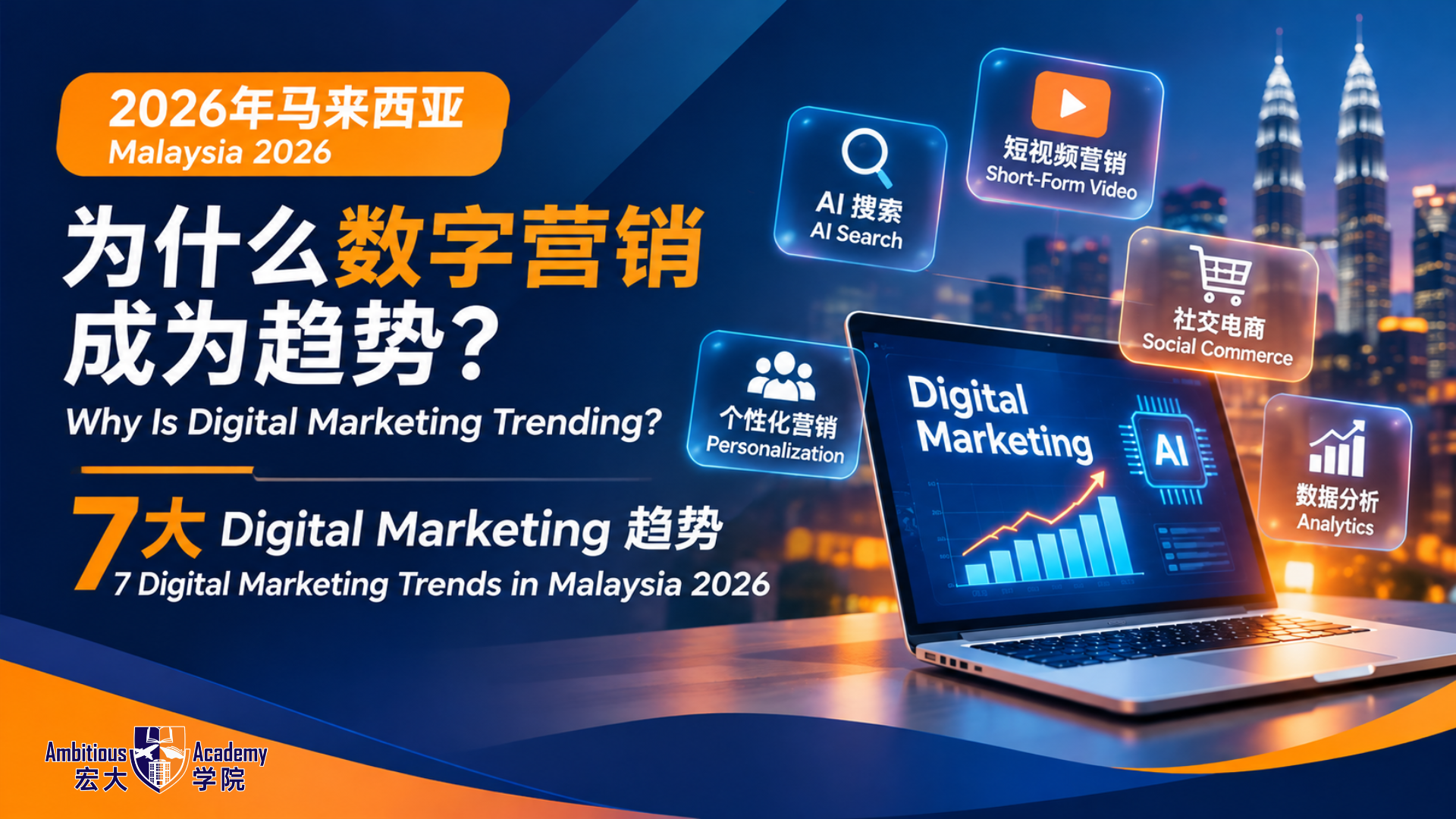
7 Key Digital Marketing Trends in Malaysia for 2026
1. AI Search Is Transforming Traditional SEO
In the past, consumers typically searched for keywords on Google and browsed multiple websites to find information.
Today, AI-powered tools such as ChatGPT, Google AI Overviews, and AI Mode allow users to ask detailed questions and receive summarised responses.
For example, instead of simply searching for “Digital Marketing Course Malaysia”, someone might ask an AI assistant:
“Which digital marketing courses in Malaysia are suitable for beginners?”
This shift means businesses need to focus on providing clear, accurate, and trustworthy information rather than relying solely on keyword optimisation.
Alongside traditional SEO, Answer Engine Optimisation (AEO) is gaining attention as businesses explore ways to make their content easier for AI-powered search systems to understand and reference.
However, Google has clarified that its AI search features continue to rely on established SEO principles and do not require special AI-specific optimisation techniques.
High-quality content, a well-structured website, and a positive user experience remain essential for digital visibility.
2. AI Is Making Content Marketing More Efficient
Artificial intelligence is becoming an increasingly valuable assistant for digital marketers.
Previously, planning a marketing campaign could involve hours of research, copywriting, graphic design, and content preparation.
Today, AI tools can support many of these tasks, including generating social media ideas, drafting video scripts, organising market research, and assisting with campaign analysis.
However, AI-generated content is not always accurate or aligned with a brand’s identity.
Businesses still need to combine AI technology with market understanding, creativity, and strategic planning to produce meaningful content.
The future of content marketing is not simply about producing more content. It is about creating content that is relevant, engaging, and valuable to the target audience.
3. Short-Form Videos Continue to Influence Consumer Behaviour
TikTok, Instagram Reels, and YouTube Shorts have become important platforms for businesses to engage with consumers.
Unlike static images or text-based advertisements, short-form videos combine visuals, sound, and storytelling to communicate messages quickly.
According to HubSpot’s State of Marketing 2026 report, short-form video remains one of the widely adopted content formats that marketers associate with strong returns.
In Malaysia, businesses across the food and beverage, beauty, retail, and education industries can use short-form videos to showcase their products, share useful information, and build brand awareness.
For example, a bakery can demonstrate how its cakes are prepared, while an educational institution can showcase classroom activities, student projects, and learning experiences.
However, successful video marketing requires more than attracting views. Businesses must also consider audience relevance, content quality, and measurable marketing outcomes.
4. Authentic Content and Brand Trust Are Becoming More Important
As AI-generated images, videos, and articles become increasingly common, consumers are exposed to a growing volume of online content.
When brands can produce content quickly, building trust and standing out from competitors becomes even more important.
Authentic customer reviews, original work, professional insights, and real-life experiences help consumers make informed decisions.
For example, an educational institution that shares genuine classroom activities, student work, and learning outcomes can provide prospective students with a clearer understanding of its learning environment.
Google’s content quality guidance also highlights the importance of Experience, Expertise, Authoritativeness, and Trustworthiness (E-E-A-T).
Therefore, content marketing in the AI era must focus not only on efficiency but also on originality, authenticity, and credibility.
5. Social Commerce Is Bringing Content and Shopping Closer Together
Social commerce is changing how consumers discover and purchase products.
Traditionally, customers might see an advertisement before visiting a physical shop or website to make a purchase.
Today, consumers can discover products through short-form videos, livestreams, and social media content before moving directly into the purchasing process.
Platforms such as TikTok Shop and Shopee provide opportunities for Malaysian businesses to connect with potential buyers.
For businesses, content creation, product demonstrations, customer engagement, and sales conversion are becoming increasingly interconnected.
This means digital marketing is no longer just about increasing followers. Businesses must also understand how to turn consumer attention into meaningful commercial opportunities.
6. Data Analytics Is Becoming Essential for Marketing Decisions
One of the major advantages of digital marketing is the ability to measure campaign performance using data.
Tools such as Google Analytics, Google Ads, and Meta Ads allow businesses to monitor website traffic, advertisement clicks, customer enquiries, and conversions.
These insights help marketers understand which channels are performing well, what content attracts customers, and whether advertising budgets are being used effectively.
AI-powered tools can also assist with organising reports and identifying patterns in marketing data.
However, data alone does not guarantee success. Marketers must interpret the results correctly and use them to make informed decisions.
Combining data analysis with business objectives and marketing strategy is becoming an increasingly important digital marketing skill.
7. Personalisation and Marketing Automation Continue to Grow
Modern consumers increasingly expect information and services that are relevant to their needs.
As a result, businesses are using Customer Relationship Management (CRM) systems, email marketing, and automation tools to deliver more personalised customer experiences.
For example, an e-commerce business may recommend products based on preferences customers have chosen to share, while an educational institution may provide course information based on a prospective student’s interests.
AI can also help businesses organise customer enquiries, plan communication workflows, and analyse marketing performance.
However, businesses must ensure that customer data is handled responsibly and in accordance with applicable privacy and data protection requirements.
The future of digital marketing involves balancing personalisation, efficiency, and consumer trust.
What Is the Future of Digital Marketing?
Looking at the major digital marketing trends in 2026, three important developments stand out.
First, AI is becoming more integrated into marketing workflows. While automation can improve efficiency, businesses still require clear strategies and objectives.
Second, content quality and consumer trust are becoming increasingly important. Authentic experiences and original content help brands differentiate themselves in a crowded digital environment.
Third, businesses are placing greater emphasis on measurable results. Rather than focusing solely on impressions and follower counts, marketers must also consider customer enquiries, conversions, and return on investment.
These developments show that digital marketing is evolving into a field that combines creativity, technology, data, and business strategy.
Why Is Learning Digital Marketing Worth Considering?
As digital marketing continues to evolve, developing relevant skills can help individuals understand how businesses reach customers, promote brands, and grow through digital platforms.
Digital marketing knowledge can be applied across industries, including retail, e-commerce, hospitality, beauty, tourism, and education.
For individuals interested in social media management, content creation, SEO, digital advertising, or entrepreneurship, learning digital marketing provides a foundation for exploring these areas.
With AI tools becoming more common, understanding how technology supports content creation, campaign planning, and marketing analysis is also increasingly valuable.
If you are interested in exploring this field, discover the Digital Marketing course offered by Ambitious Academy to learn more about the course structure, entry requirements, and available learning opportunities.
Frequently Asked Questions (FAQ)
1. Why is digital marketing important in 2026?
Digital marketing is important because consumers increasingly use the internet, social media, and AI-powered tools to discover information and evaluate products or services. It helps businesses reach target audiences, build brand awareness, and measure marketing performance.
2. Will AI replace SEO?
AI is changing how consumers search for information, but SEO remains important for improving website visibility. Businesses still need high-quality content, accessible websites, and effective search optimisation strategies.
3. Can beginners learn digital marketing without experience?
Yes. Beginners can start by learning the fundamentals of social media marketing, content creation, SEO, and marketing analytics. They can then develop more specialised skills based on their interests and career goals.
Conclusion: Digital Marketing Is Entering a New Era
Digital marketing is growing not simply because internet usage is widespread, but because AI, short-form videos, social commerce, and data technologies are continuously changing how businesses interact with consumers.
For Malaysian businesses, digital marketing has become an important part of brand promotion and business development.
Companies that successfully combine artificial intelligence, creative content, consumer insights, and data analytics will be better positioned to compete in an increasingly digital marketplace.
Digital marketing is not slowing down. It is evolving into a new era shaped by AI and changing consumer behaviour.
Interested in exploring digital marketing as a field of study? Visit Ambitious Academy’s Digital Marketing course page to learn more about the programme.